Why talk after the story?
Reading a book aloud is good; talking about it is better. Studies of dialogic reading, an approach developed by Grover Whitehurst and colleagues in which the adult asks questions and the child gradually becomes the storyteller, found clear gains in young children’s expressive vocabulary compared with reading straight through. The key is open questions that the child can answer in their own words, followed by expanding on what they say.
- Ask open questions, not only yes/no ones
- Repeat and expand the child’s answer
- Praise the thinking, not only the right answer
- Keep it short: two or three questions is plenty
Questions for toddlers (ages 2-3)
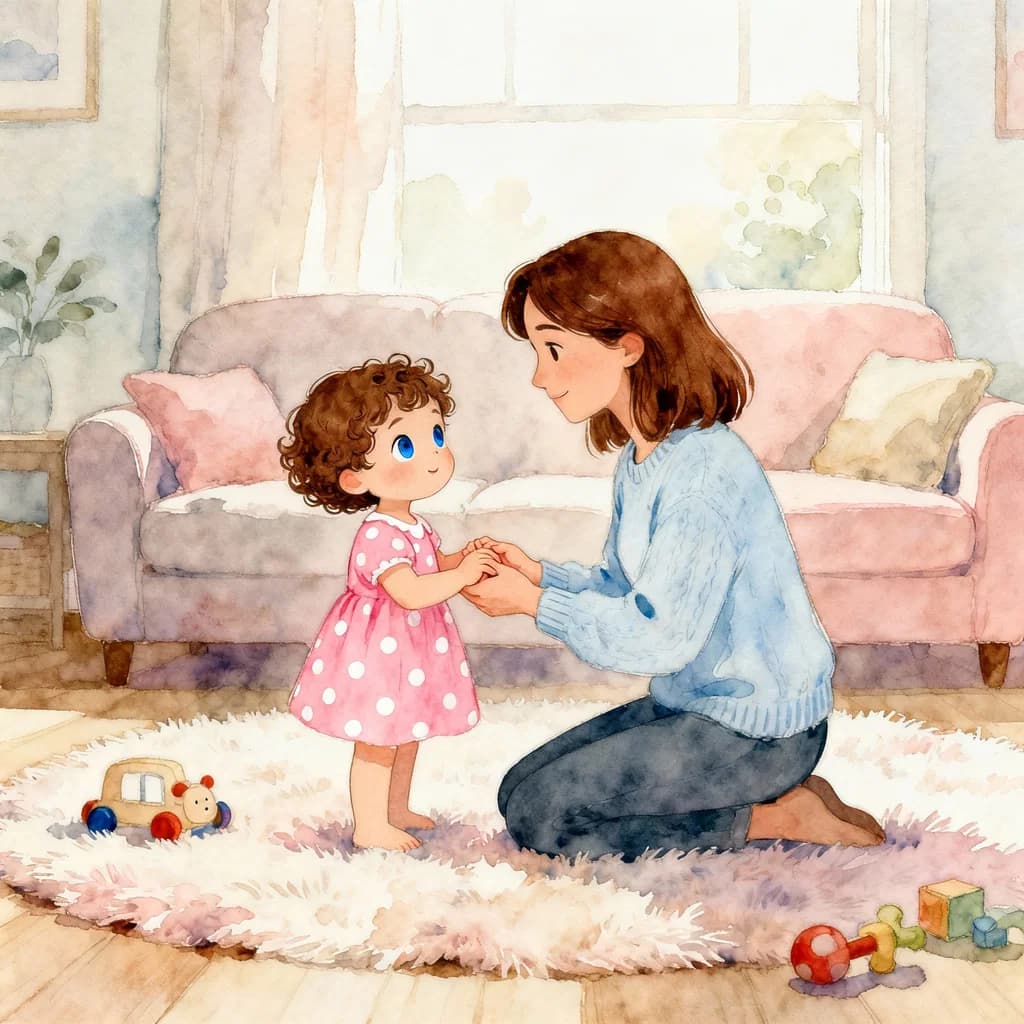
Keep questions concrete and point at the pictures. Ask “What is this?”, “Where is the dog?”, “What sound does the cow make?” or “What colour is the balloon?”. Let your child answer by pointing, and add a word: “Yes, the big red balloon!”. Finishing a repeated line from the book also counts as an answer at this age.
Questions for preschoolers (ages 4-5)
Move from naming to remembering and feeling. Try “What happened first?”, “Why was the bear sad?”, “What do you think will happen next?” and “Has that ever happened to you?”. Predictions and personal connections are especially powerful: they ask the child to think beyond the page while staying inside the story.
Questions for early readers (ages 6-8 and up)
Ask about reasons, choices and opinions. “Why did she decide to go back?”, “What would you have done?”, “Which part was the most exciting, and why?”, “How did the character change from the beginning to the end?”. Older children can also retell the story in a few sentences or invent a different ending, which builds summarising and narrative skills.
Use the PEER and CROWD prompts
Dialogic reading is often summarised with two acronyms. PEER describes the exchange: Prompt the child, Evaluate the answer, Expand it, and Repeat the prompt. CROWD lists five kinds of prompts: Completion (finish the sentence), Recall (what happened), Open-ended (tell me about this picture), Wh- questions (who, what, where, why) and Distancing (connect the story to the child’s own life). Mixing two or three kinds keeps the conversation natural.
Ready-made questions for every ChildrenBooks story
You do not have to come up with questions yourself. Every story on ChildrenBooks ends with two short word games, and the final screen suggests open questions written for that particular book, along with the words your child practised and their meanings. Read the story, play for five minutes, then pick one question to talk about over dinner or at bedtime.